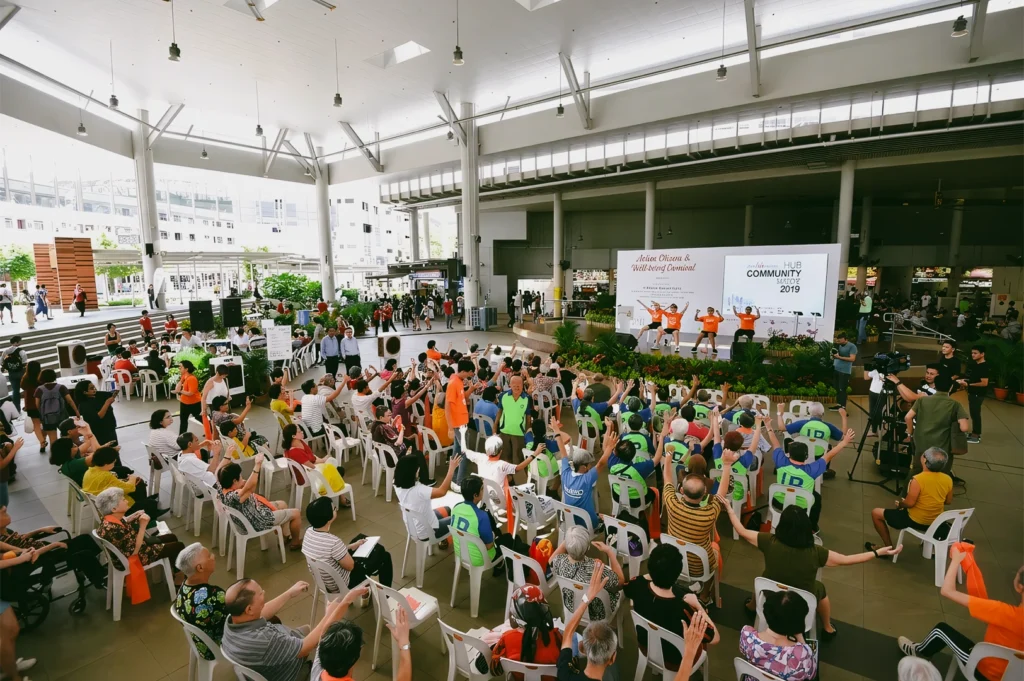
Last month, we spent a Saturday evening at a small neighborhood event in Clementi. Nothing particularly grand was happening — a few food stalls lined the basketball court, children were painting tote bags at folding tables, and a local uncle was singing old Mandarin songs slightly off-key into a microphone that kept cutting out.
And yet, almost the entire estate seemed to show up.
Families brought camping chairs from home. Teenagers hovered near bubble tea stalls while pretending not to enjoy the live performances. Elderly residents sat together under sheltered walkways chatting long after the official programme ended. By 9PM, people who probably hadn’t spoken in months were sharing snacks and waving at one another like old neighbors again.
It reminded us that community events in Singapore are rarely just about the activities themselves.
They create pauses in daily life.
Singapore moves quickly most of the time. People leave for work before sunrise, rush between errands, and return home exhausted. Many neighborhoods can feel strangely quiet despite thousands of people living side by side. But during community events, familiar spaces temporarily change. Void decks become gathering spaces. Carparks transform into night markets. Open fields fill with performances, laughter, and conversations between strangers.
Even small events have a way of softening the invisible distance between residents.
We’ve noticed this especially during festive seasons. Whether it’s Hari Raya bazaars, Mid-Autumn lantern walks, Deepavali celebrations, or Christmas light-ups organized by local committees, people naturally linger longer outdoors. Children meet other children from nearby blocks. New residents start recognizing familiar faces. Food becomes shared conversation — something deeply tied to the identity of every estate and community in Singapore — discover here.
There’s something deeply comforting about seeing an entire neighborhood briefly slow down together.
In recent years, many younger Singaporeans have also started attending these events again, not out of obligation, but because they’re searching for a stronger sense of belonging close to home. Community events offer something digital spaces often cannot: spontaneous interaction, shared memory, and the feeling of physically being part of a neighborhood.
Not every event is polished. Some are noisy. Some are awkwardly organized. But maybe that’s part of their charm.
They remind us that neighborhoods are not just places we live in.
They’re places we build together.