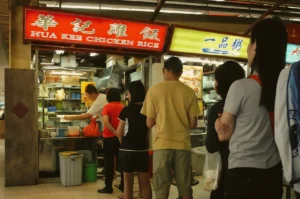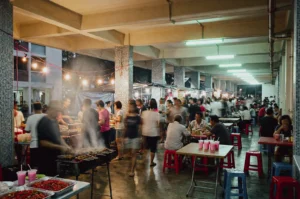
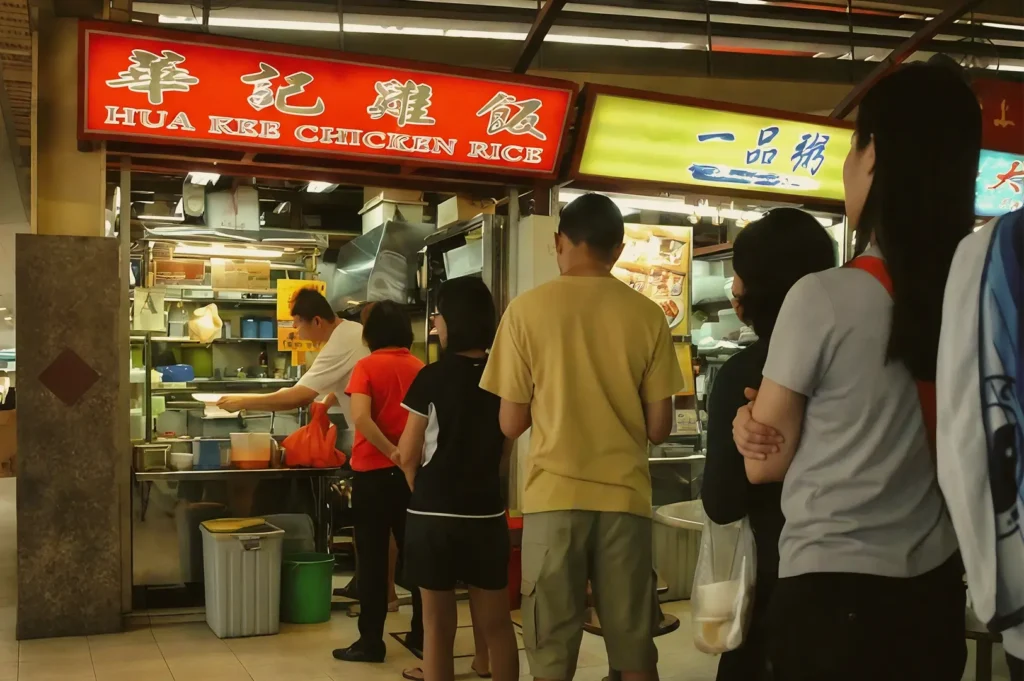
It is 12:45 PM on a Tuesday. You are standing in the middle of a crowded hawker centre, the ambient heat mixing with the roar of industrial exhaust fans. You have exactly forty-five minutes before your next meeting. You scan the glowing signboards—noodles, mixed rice, Western fare—but your brain is too fatigued to make a real choice.
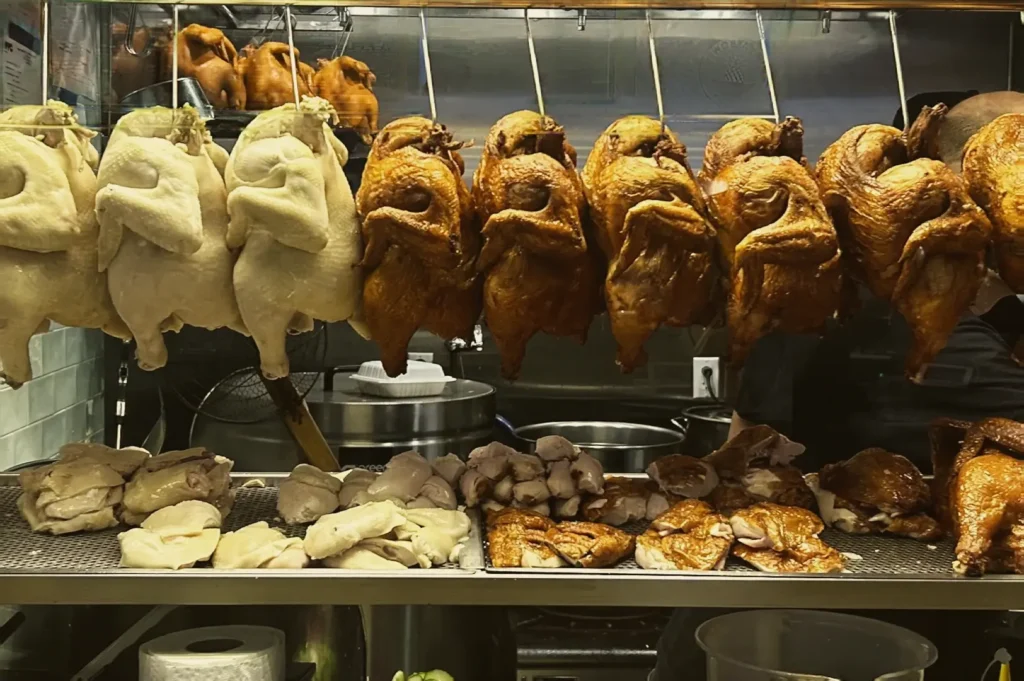
Your eyes land on a row of pale, plump chickens hanging behind a glass pane. You join the queue at one of the many chicken rice stalls. When you reach the front, the exchange is brief and transactional: “Chicken rice, roasted, eat here.“
You did not choose Hainanese chicken rice because you were struck by a sudden, overwhelming craving. You chose it because it required zero mental friction. In Singapore, this deceptively simple dish operates less as a culinary indulgence and more as an essential piece of daily infrastructure. It is the universal fallback, the ultimate “no-decision” meal. We eat it when we are in a hurry, when we are tired, and when we simply want something that works exactly the way we expect it to.
Traditional Hainanese Chicken Rice Became Everyday Food in Singapore
The dish we eat today is a pragmatic evolution of a migrant recipe. Early Hainanese immigrants brought the concept of Wenchang chicken—a bony, free-range fowl cooked in a sub-boiling master stock—to Southeast Asia. However, the dish did not stay stagnant. Over decades, local cooks adapted the recipe to suit the resources and tastes of their new environment.
They began using younger, fleshier birds, often chicken breast or whole poached chicken. They introduced the Cantonese technique of plunging the cooked chicken into an ice bath to tighten the skin, resulting in tender, succulent meat with a gelatinous skin. They developed the bright, acidic chilli sauce and the perfect dipping sauce to cut through the oppressive tropical heat.
But the real reason Hainanese chicken rice became Singapore’s national dish is not just about flavor. It is about accessibility. As Singapore rapidly urbanized, the population needed food that was cheap, fast, and satisfying. Chicken rice scaled perfectly. A single hawker stall could prepare dozens of birds before the lunch rush, chop them to order in seconds, and feed hundreds of workers in an hour. It shifted from being a specific cultural heritage dish to a mass-market, everyday utility.
The Different Ways Chicken Rice Shows Up in Singapore
Despite its ubiquity, familiarity does not equal sameness. Walk into any hawker centres or restaurants, and you will find that the dish splits into a few distinct variations. The core components—chicken, fragrant rice cooked in chicken stock and chicken fat, chilli, and dark soya sauce—remain constant, but the execution shifts.
Other meat dishes like char siew (barbecued pork) rice are often served at hawker centres, offering diners additional options alongside chicken rice. With so many other stalls offering their own take on Hainanese chicken rice Singapore, there is plenty of variety for those who want to explore different vendors and find their personal favourite.
For readers who want to see how these differences play out on the ground, Hainanese Chicken Rice Singapore: 5 Spots Serving the City’s Most Familiar Dish offers a useful look at how familiar ingredients can produce very different experiences from stall to stall.
The Standard Expectation: Poached Chicken and Steamed Chicken Rice
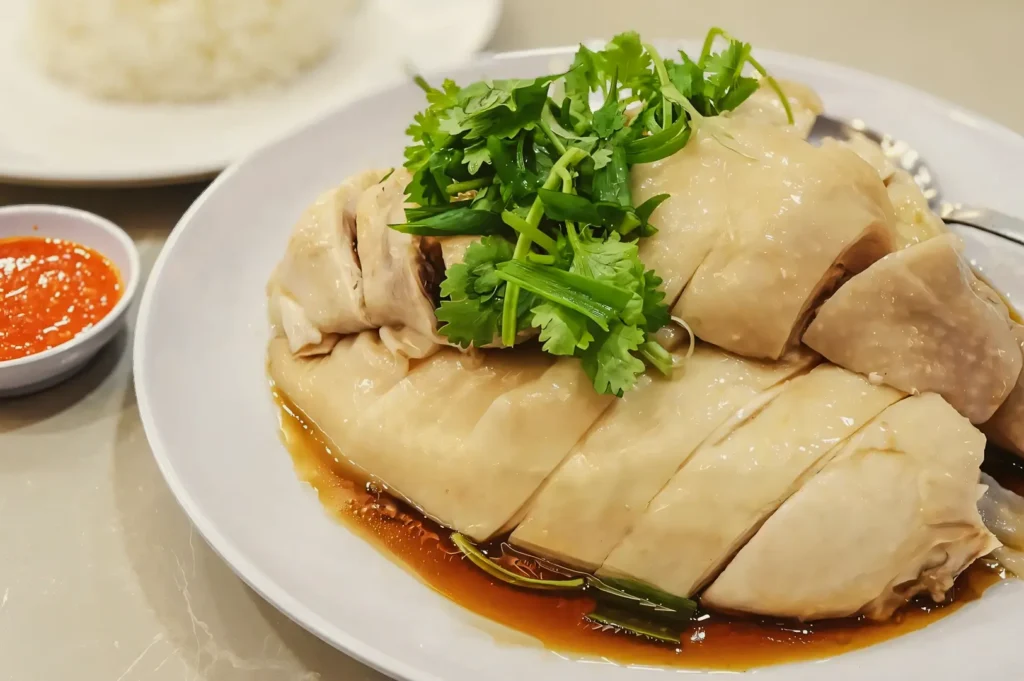
The poached chicken, or “white” chicken, is the baseline against which all stalls are measured. The meat should be tender, juicy chicken with skin that is silky and gelatinous, heavily reliant on the underlying chicken broth and sesame oil dressing. The chicken is typically served as chopped chicken, cut into bite-sized pieces for easy eating. The rice served alongside is typically jasmine rice, pre-fried in chicken fat with aromatics like ginger and garlic, then steamed in chicken broth.
Even within this standard category, micro-preferences dictate where people eat. At Maxwell Food Centre, the lines for Tian Tian Hainanese Chicken Rice stretch relentlessly. Diners wait for their famously smooth chicken and the signature savory sauce drizzled over the meat. Yet, just a stone’s throw away, emphasizing the close proximity, a different crowd lines up at Ah Tai Hainanese Chicken Rice.
Opened by a former head chef from Tian Tian, Ah Tai offers a distinctly different profile—a sharper, more acidic chilli and flavourful rice that carries a punchier garlic and ginger note. They are the same style of dish, sitting in the same hawker centre, but they cater to slightly different expectations.
The Pragmatic Alternative: Roasted Chicken and Soya Sauce Chicken Rice
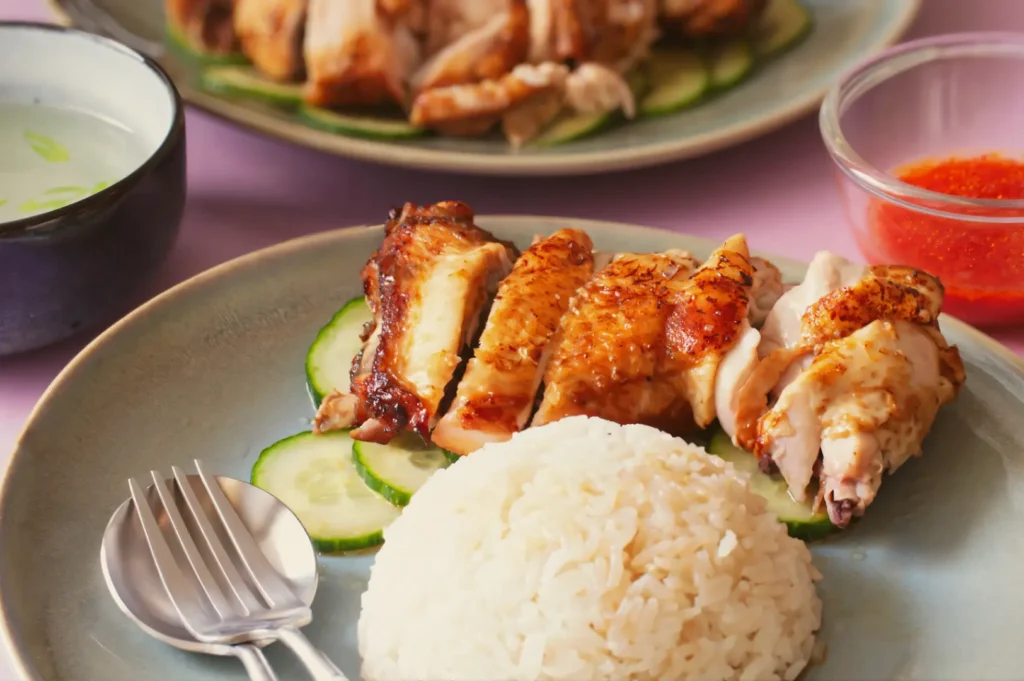
The “roasted chicken” variation is technically flash-fried, resulting in a thin, dry, mahogany skin. It is the pragmatic choice for diners who dislike the slippery texture of steamed chicken skin. The meat tends to be slightly firmer, carrying the savory depth of its marinade.
A quieter, but equally entrenched variation is soya sauce chicken rice, where the chicken is braised in a dark soy sauce and spices. This method yields a deeply flavored bird with a dark, uniform exterior. You find this style holding steady in older, heritage establishments like Boon Tong Kee, which has several outlets including one near Holland Drive. The dish here is served with flavourful rice, a bowl of chicken soup, and side dishes such as pork chop and chap chye, offering a complete meal experience.
The Elevated Baseline: Premium Chicken Rice at Marina Square and Beyond
Eventually, chicken rice moved off the streets and into air-conditioned dining rooms. The premium interpretation does not reinvent the dish; it simply throws resources at it.
At Chatterbox, located in the Hilton Orchard and Marina Square, the dish is treated with the precision of fine dining. The price point jumps significantly, but the delivery changes. The chickens are larger and meticulously sourced. The rice is cooked in a highly refined, slow-simmered chicken broth. You are not just paying for a better cut of meat; you are paying for the space, the service, and the guarantee of absolute consistency.
How People Actually Eat Chicken Rice in Singapore
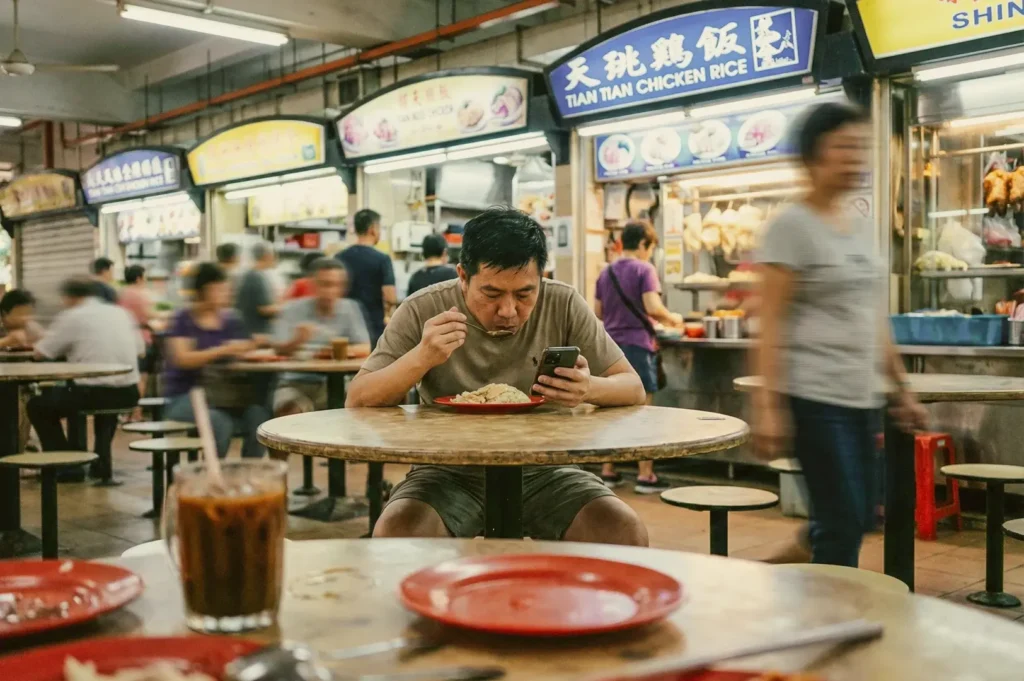
If you watch how people interact with this dish on a daily basis, you realize it is rarely treated as a celebratory event. It fits into the unglamorous, necessary pockets of our routines. Hainanese chicken rice in Singapore is typically served with slices of fresh cucumbers, which add a refreshing contrast to the rich flavors of the tender chicken and fragrant rice.
There is the quick solo lunch. An office worker sits at a small plastic table, scrolling through their phone with one hand while using a spoon and fork to mix the chilli sauce and dark soy sauce with the other. The meal is consumed efficiently, often in under twenty minutes, providing just enough carbohydrate-heavy energy to survive the afternoon slump. A typical Hainanese chicken rice meal costs between SGD $3.50 to $6, depending on the stall and the options chosen.
There is the fallback dinner. A tired parent, driving home after a long shift, stops by a neighborhood stall to buy three identical brown paper packets of chicken rice. It requires no cooking, minimal cleanup, and no arguments from the children.
It is also the late-night default. When shifts run long or evening plans end past midnight, the 24-hour chicken rice stall provides a reliable, heavy anchor before sleep. It is not about the culinary experience; it is about functional comfort and a dependable chicken rice fix.
Why People Keep Coming Back to Singapore Chicken Rice
In a city with an overwhelming density of food options, the enduring dominance of chicken rice comes down to behavioral economics. We default to it for a few very practical reasons.
Consistency: A plate of chicken rice rarely surprises you. Whether it is excellent or just average, it generally tastes like chicken rice. You know exactly what you are getting.
Speed: The assembly requires mere seconds. The chicken is pre-cooked, the aromatic rice is ready in the cooker. A skilled hawker can chop and plate a portion in under a minute.
Price: Despite inflation, it remains one of the most affordable complete meals available in the city. It provides a highly effective ratio of cost to caloric intake.
Familiarity: It demands very low mental effort. When decision fatigue sets in, ordering chicken rice is a reflex. You do not need to study a menu.
From Hawker Stalls to Hotel Menus: The Spectrum of Eating Chicken Rice
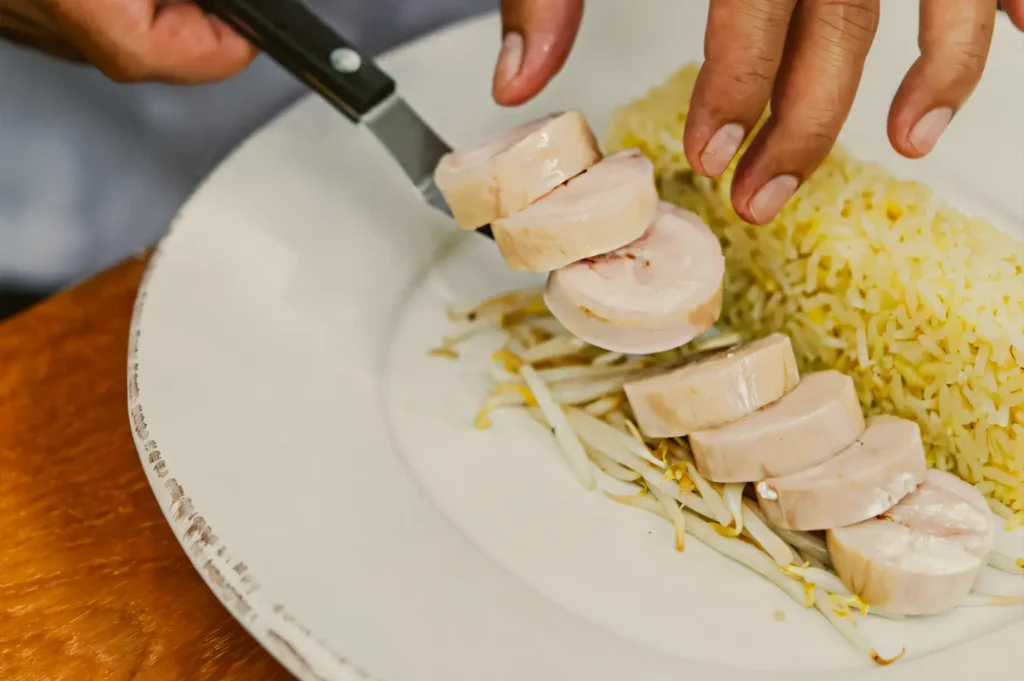
The environment where you eat chicken rice drastically alters the experience, even if the core components remain the same.
At a hawker stall, the experience is raw and efficient. The auditory backdrop is the rhythmic chopping of the cleaver on a wooden block. You eat amidst the heat, wiping sweat from your forehead with a tissue packet. The transaction is fast, cheap, and entirely unpretentious.
When you move to chain brands in shopping malls like Marina Square, the experience becomes standardized. The temperature is controlled, the seating is guaranteed, and the chilli sauce comes in neat, easily accessible condiment stations. It trades the raw energy of the hawker centre for predictability and comfort.
In a hotel or premium restaurant, the dish becomes a localized luxury. The frantic pace disappears. You eat slowly, noticing the subtle nuances in the ginger paste and the specific chicken fat content of the rice. The format shifts the dish from a quick refueling stop into a deliberate dining experience.
Conclusion
Hainanese chicken rice does not dominate Singapore’s food landscape because it is the most complex or exciting dish available. It dominates because it works. It is the quiet, reliable engine of our daily dining habits. It fills the gaps when we are too busy to think, too tired to cook, or simply in need of something universally familiar.
We eat it so often that we stop looking at it. We consume it on autopilot. But the next time you find yourself standing in that queue at Maxwell Food Centre or Marina Square, ordering your usual plate without a second thought, take a moment to actually pay attention to what sits in front of you.
Notice the texture of the rice grains, the fragrant rice cooked in chicken stock with just the right amount of chicken fat. Pay attention to the bite of the chilli, the viscosity of the dark soya sauce, and the temperature of the chicken. Alternatively, explore the variety of chicken rice stalls scattered throughout the city that you might have overlooked before. The dish may be a pragmatic default, but recognizing the small, deliberate differences is what makes eating in this city endlessly interesting.