
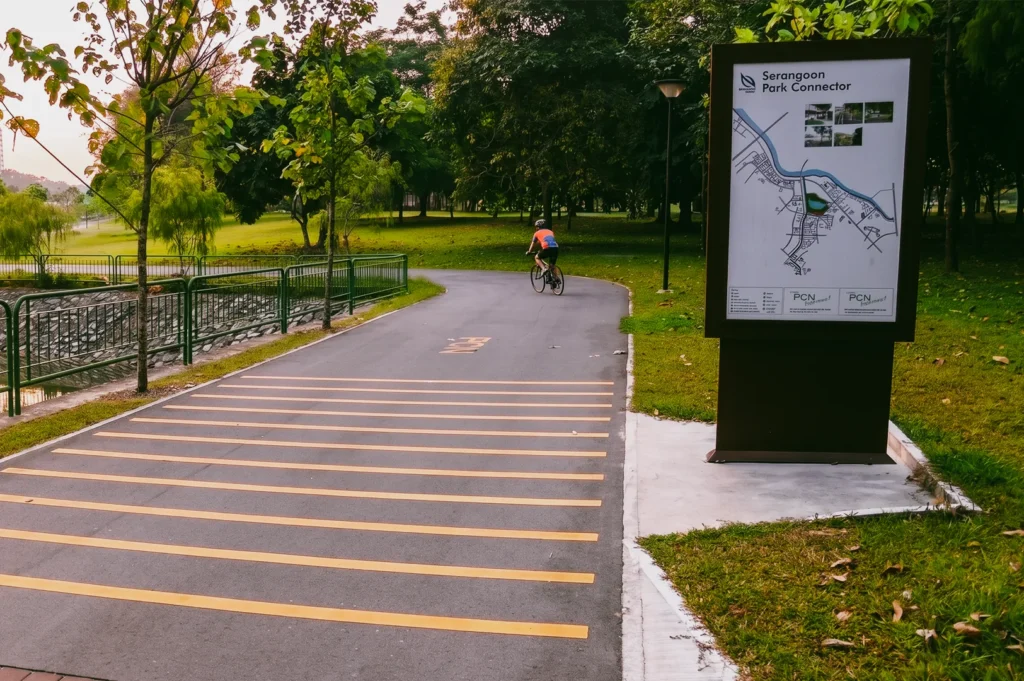
The city was still waking up as I wheeled my bicycle onto the park connector. A thin veil of mist hung over the paths, softening the edges of the familiar trees and walkways.
The early light filtered through the leaves, scattering gold across the pavement and casting long, gentle shadows.
I passed the first familiar face, a jogger I often see at this hour, earbuds in, nodding slightly in greeting as our paths crossed.
We didn’t speak, but the recognition felt like an unspoken rhythm, a quiet marker of shared space and time.
Further along, a grandmother balanced her grandchild on the pedals of a small bike, her hands steadying the frame, their laughter punctuating the dawn.
Nearby, a young man practiced tai chi, his movements slow, deliberate, and fluid, as if tracing invisible connections across the air.
Each of these moments, separate yet occurring on the same path, created a subtle choreography of human presence.
The connectors themselves guided the interactions. The width of the paths allowed cyclists, runners, and walkers to coexist without congestion, yet narrowed sections naturally slowed traffic, forcing brief, meaningful exchanges.
A nod here, a smile there, a polite “morning” to someone passing in the opposite direction, small acts that quietly anchor the day.
I paused at a bridge overlooking a canal, listening to the water ripple past the mangroves. In that brief stillness, I noticed how the neighbourhood came alive without the usual clamor of cars or city noise.
The plants, the birds, the soft clatter of a bike chain all combined to create a space where nature and routine intersected.
It was not just a path for movement, it was a living artery, carrying the quiet pulse of the community.
For those looking to extend these moments, Singapore Picnic Food: The Ultimate Guide to Takeaway Eats for Every Green Space offers suggestions for snacks and meals you can bring to fully enjoy the calm of these green corridors.
At a junction, a street cleaner waved briefly at me, a gesture of recognition earned through countless mornings shared along this route.
The little interactions, between neighbours, commuters, and strangers, built a lattice of connection that no signage or schedule could replicate.
Here, the park connector acted not only as a physical route but as a social one, fostering familiarity without imposing it.
I thought about the runners, the dog walkers, and the parents ferrying children to school. Each brought their own pace, their own story, their own sense of belonging.
Together, they layered moments over the same space, giving the connector its quiet, collective heartbeat.
As the sun climbed higher and shadows retreated, the park grew busier. Conversations began in earnest, wheels spun faster, and the rhythm shifted from meditative to energetic.
Yet even amidst the increase in activity, the connector maintained its role as a shared canvas for movement, interaction, and observation.
Cycling onward, I felt the quiet lesson of the morning: neighbourhood life is not only held in homes or community halls.
It lives in the pathways we traverse, in the bridges we cross, and in the familiar faces we pass each day.
The park connector is more than concrete and asphalt; it is a framework for connection, a pulse of the city, and a quiet reminder that community exists in the spaces we often take for granted.
By the time I reached the end of my route, the city’s hum had begun in earnest, yet the morning’s rhythm lingered.
I dismounted, taking a final look at the path.
The park connector had carried more than bicycles, it had carried moments, routines, and the subtle, enduring thread of everyday life.