Certain smells immediately place us somewhere familiar, even before we consciously register our surroundings. In many of Singapore’s older districts, one of those scents is incense drifting softly along the five-foot way.
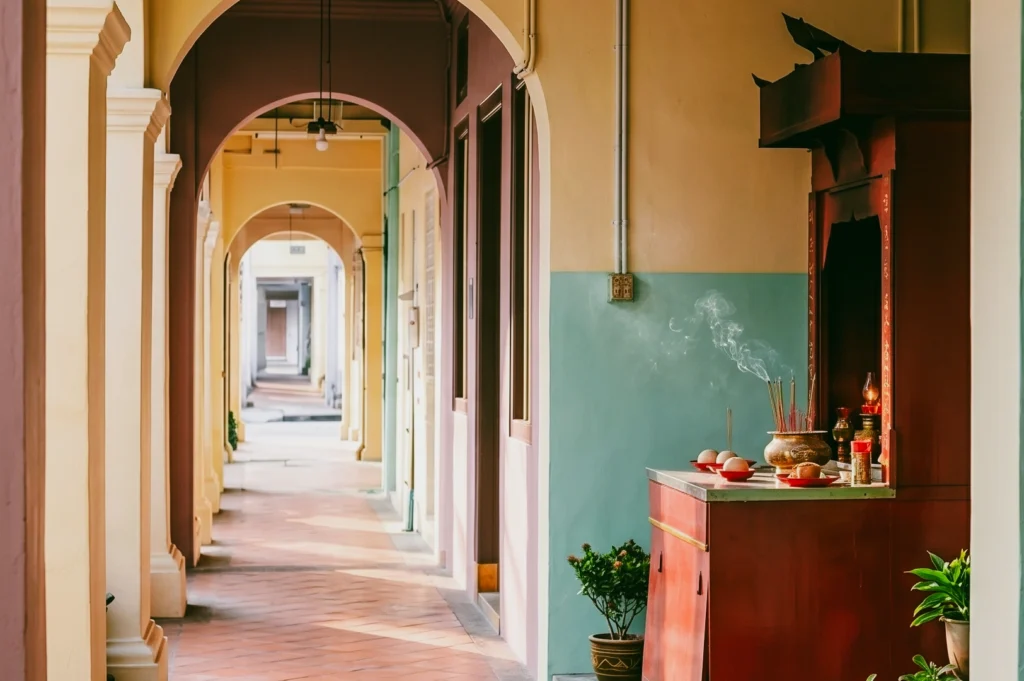
Walk through Chinatown, Little India, or stretches of Geylang early in the morning and the smell appears almost everywhere at once. Thin trails of smoke curl upward from small altars tucked beside shop entrances. Joss sticks burn quietly beneath faded signboards. Outside temples, elderly residents pause briefly before continuing with the routines of the day.
These moments are so deeply woven into the rhythm of neighbourhood life that many of us barely notice them anymore.
Yet incense continues shaping the emotional atmosphere of older streets in subtle but powerful ways. The scent lingers beneath covered walkways, blending with the aroma of kopi, fresh bread, damp concrete after rain, and the distant sound of shutters rolling open for business. Together, these sensory details create an environment that feels unmistakably rooted in place.
In Singapore’s historic districts, incense rarely exists in isolation from daily life. It accompanies ordinary routines rather than interrupting them. Delivery workers weave past temple entrances while prayers continue quietly in the background. Shopkeepers light joss sticks before opening for the morning. Families leave small offerings near doorways before heading to work or school.
These practices reveal how heritage often survives not through grand ceremonies alone, but through repetition.
The five-foot way itself becomes part of this continuity. Originally designed as transitional public spaces linking shophouses together, these covered walkways still function as communal corridors where religion, business, conversation, and routine naturally overlap. Incense drifts through all of it, connecting temples, homes, and storefronts into a shared sensory landscape.
As Singapore modernises, many older neighbourhood rituals inevitably become less visible. Redevelopment changes the texture of streets. New businesses replace older tenants. Daily life moves faster. Yet the quiet presence of incense remains one of the small details still anchoring certain districts to their cultural memory.
Sometimes, the identity of a neighbourhood is not preserved through landmarks alone. Sometimes it survives through something as fleeting as smoke drifting slowly through the morning air.